Advert


Wednesday, 15 May 2013

How to Lead Great Leaders

How to Lead Great Leaders:
Leading has its challenges, but when your followers are powerful leaders you need to step up your game. Here are six helpful tips.
As a boss or team leader, you have to lead people every day. It makes life easier when you have established authority and your followers are generally compliant. But someday you may find yourself leading powerful leaders, perhaps for a board meeting, a nonprofit, or even a high-level management team. These focused and dynamic people create completely different challenges for a facilitator.
This was my exact challenge this week in London. I was honored to moderate a panel for the G8 Young Summit (G8YS) and was quickly recruited to help facilitate 35 young leaders to create an important, detailed communiqué for the heads of state from G8 countries, all in 24 hours. These young leaders, from more than 14 countries, many of whom had never before met, were described at the event by keynote Matthew Bishop of the Economist as the people who will control the world in 2030. They are all strong-willed, successful, passionate entrepreneurs with healthy egos, varied points of view, and independent agendas.
I am happy to say that after an intense and spirited discussion we achieved our goal, but only because of agile facilitation practices, some of which I knew well and some of which I had to improvise along the way.
1. Prepare
At G8YS, much of the attendee list was in flux until the day we started, so we had to work on the fly. If you are blessed with advance time, give attendees plenty of information to ready them for the discussion. Use subject matter experts to help frame the conversation in writing, preferably days in advance. Send the attendees a bulleted e-mail with key points and objectives so you don't waste valuable meeting time while preparing them for discussion.
2. Manage Expectations
Make sure your attendees are absolutely clear and aligned on both the objectives and the deliverables. Strong leaders will likely have varied views of the level of depth and detail required in a solution or document. Your job is to make sure you are all working toward the same goal. You also have to make sure the deliverables can be completed within the available timeframe or you will take the blame. Take a little extra time initially to determine a clear and appropriate scope. Then constantly remind everyone in case they stray to their own standards.
3. Keep Everyone Equal
In a free discussion, some people will dominate and others will hang back, letting others talk. Your job is to bring everyone's ideas to the forefront so all can be heard. When soliciting input, start by having everyone take a few minutes to jot down specific ideas on paper. Give them tight structure, such as asking for only two or three responses. If there is time, each person can read his or her notes. Or if consensus is close, simply vote with hands and ask if anything was missed. Don't be afraid to cut someone off if they are hogging the conversation. They might think you are a little rude and bossy, but the other people at the session will appreciate you keeping time and input in balance.
4. Maintain Clear Priorities
Passionate people will follow their passion especially when it's coming out of their mouth. Strong advocates can derail a discussion by constantly dragging it back to their own agendas. Your job is to keep the focus on the objectives and deliverables. Write down the discussion focus at the top of the whiteboard so you can simply point to it when correcting a digression. Guide the group toward expansive thinking early and then tighten the boundaries to refine and get to consensus. You have to own the conversation or your leaders will push you aside and take it their own direction.
5. Step Out of Situational Conflict
It's not your job to make people play nice. Spirited debate and healthy conflict can add to the depth of the result. When flare-ups happen, let them go, at least for a bit. Otherwise your participants will feel stifled or unresolved. Let them express enough to verify they have been heard without overusing the time required to complete your task. Of course, recognize that strong advocates may never feel fully heard if the group agrees to go a different way. In this case, make sure that you acknowledge the issue and focus the advocate on the need to meet objectives and deliverables within time constraints.
6. Be Firm but Gracious
When facilitating leaders you have to show strength and self-confidence. You may or may not have time to build trust, but you still have a job to do and you are accountable for completing the task. Many in the group may feel they could do better and they indeed may be right, but this is your session and you must take absolute ownership even if it means politely rejecting the people you admire and respect. As long as you keep a sense of humor and advocate for the priority, most leaders will respect your approach within the context of a difficult challenge. Make sure at the end you acknowledge the participation and patience of each member of your group. Show appreciation and grace; voice your pride in the successful accomplishment of the team deliverables.
Like this post? If so, sign up here and never miss out on Kevin's thoughts and humor.


4 Reasons to Become a Mentor

4 Reasons to Become a Mentor:
No one says you have to help out a fledgling fellow entrepreneur once you've found success. But there are some pretty compelling reasons to do so.
One of the enduring mysteries of human nature is why a very successful business person would give away his time to help an up-and-comer. After all, given the mentor’s success, he easily could charge the protégé $500 an hour for the valuable advice and contacts that he has pulled together during his career.
And yet mentoring is a widely accepted practice. To figure out why, I spoke with Mike Bergelson, CEO of Everwise, a service that connects mentors and protégées. It’s a mentoring company that benefits from being near a key mentor. Bergelson--who started Audium, a software company in New York City that Cisco acquired in 2006--ended up moving to California as a Cisco executive.
He left Cisco and pulled together the team from the software start-up to work on business ideas. But Everwise did not gel until 2012 when Bergelson discussed these ideas with Maynard Webb, his mentor, whose Webb Investment Network (WIN) offers “young entrepreneurs seed capital, mentorship, and on-demand access to experts.”
Thanks to his conversations with Webb, Bergelson decided to focus solely on mentoring. As he explained, “Maynard asked questions that made me realize that I had a passion for creating a way for corporate protégés to find mentors and that addressing that need could be a big opportunity.”
Bergelson knew first-hand how commonly big companies miss the opportunity to match protégés with mentors. That’s because when he was working for one of those big companies, he was given the name of his mentor. That person never responded to Bergelson’s email suggesting a meeting. A few weeks later, the mentor had quit and the company never gave Bergelson another.
Still, Bergelson believes mentoring is a great way for big companies like his former employer to develop talent. A study by a former Sun Microsystems executive found that employees who received mentoring were five times more likely to be promoted. And a study of successful people like Warren Buffett found that the second most important reason they believe they’ve been successful is great mentors (Buffett’s was Benjamin Graham).
Everwise has developed an algorithm that has contributed to a “96 percent match satisfaction rate.” Assuming that’s true, Bergelson should be an authority on why people agree to serve as mentors. Here are his four top reasons.
1. Give Back
Successful people I have interviewed often say that they were helped early in their career by someone who had achieved greatness. Now they believe that they should “pay it forward.”
But why do they feel that way? Some feel that they are repaying a debt to future generations; others believe that if their advice helps a younger person, it will make a little piece of them immortal; still others see mentoring as going back in a time machine and giving a younger version of themselves the advice that they wish they had received.
This last reason highlights the importance of matching the right mentor and protégé. After all, if a mentor finds a young person with similar life experiences--such as emigrating from Chile or competing in triathlons--it will strengthen the feeling of giving back to a younger version of herself.
2. Learn From Process
Many mentors claim that they learn by teaching. This observation brings to mind the Seinfeld episode about mentoring. In case you missed it, George Costanza needs to learn about risk management so he asks his protégé to record herself reading the book to him. (Naturally, Costanza took the idea of learning from mentoring and turning it on its head.)
Bergelson said that many mentors learn through the process of teaching others and they find that mentoring makes them better leaders. He said that 94 percent of mentors agree to repeat their experience because they “take away a lot from the process.”
3. Meet New People
Mentors also like the idea of meeting new people whom they can add to their “I knew when” list. After all, who doesn’t like the idea of bragging to associates that they knew [currently famous person X] before they became successful?
For mentors with this motive, there is also a potential financial benefit. The protégé might offer the mentor an opportunity to invest in an early-stage venture. And if that happens, the mentor may not only get bragging rights but a big slug of cash when he sells stock in the now successful venture.
4. Get Exposed to New Ideas
Protégés also expose mentors to new ideas. For example, the protégé might discuss how her company is using a new approach to innovation, pricing, or customer service. Mentors may be able to apply some of these best practices to their own activities.
People are willing to mentor for free because they already have--in the context of Maslow’s Hierarchy of Needs--met their physiological and safety needs and now seek esteem and self-actualization. Mentoring is a way to get there.


Wednesday, 8 May 2013

Opinion - Why Women Can’t Have Unemotional Sex By Preston Waters

Opinion - Why Women Can’t Have Unemotional Sex By Preston Waters:


Actress Afro Candy Produces Nigeria’s First Hard Core Porn Movie

Actress Afro Candy Produces Nigeria’s First Hard Core Porn Movie:


4 Reasons Business Owners Are Not Confident About the Economy

4 Reasons Business Owners Are Not Confident About the Economy:
Take a closer look at some of the fundamentals underlying the recent positive economic news.
In its monthly "beige book" report, the Federal Reserve recently reported moderate economic growth across the country. This was backed up by gross domestic product numbers, which showed a 2.5 percent annualized growth in the first quarter--a significant improvement from the 0.4 percent annualized growth from the fourth quarter of 2012. The unemployment rate continues to tick down. Personal income and spending both increased, pending home sales reached a three-year high, new residential home sales improved, and home prices are surging. The American auto industry had its best performance in 20 years. Most economic indicators seem to be in the normal range.
But--hold on a minute. A recent report found that U.S. home ownership fell to its lowest level since 1995. Both manufacturing activity in the country and orders for durable goods plunged last month. A Kauffman report revealed that entrepreneurial activity declined last year, and the National Federation of Independent Businesses said last month that small business confidence remains at historically low levels. If that's not bad enough, the University of Michigan said that consumer sentiment fell to a three-month low, and, separately, port traffic in the Los Angeles area decreased in March. Things are so gloomy that more than 12 million Americans actually believe that lizard people are running the country.
So is the economy in good shape--or not?
Why are so many small business owners still not feeling as confident as they did a few years ago? The fact is that most of the business people I speak with are very tentative, still uncertain, and still very concerned about some of the fundamentals underlying the numbers.
Here's four reasons why:
1. A deficit decline is not sustainable.
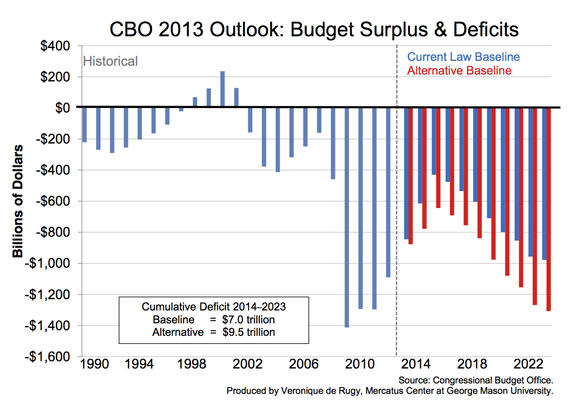
Since 2009 the country has become accustomed to a trillion-dollar annual deficit. I've been watching, with a growing sense of panic, the U.S. national debt, which is now approaching $17 trillion and is, for the first time in U.S. history, greater than the entire national output. But some are celebrating. That's because many projections now show that, with rising tax receipts and some cuts in government spending, the deficit this year is projected to fall to under $800 billion. And the projected annual deficit is estimated will decrease to as little (as little?) as $600 billion by 2015. This doesn't mean the deficit is under control, and you know it. Back in 2007, the deficit was "only" $161 billion and even that was too high. Remember, this is all adding to the country's national debt. And after 2015, the deficit is projected to increase yet again, soon surpassing a trillion dollars a year as the costs of health care, social security, and other entitlements begin kicking in with a vengeance. The business owners I know aren't buying into the myth that the deficit is coming down. The long-term debt could affect the U.S. economy as it's now doing in parts of Europe: rising interest, cuts in spending, tax increases, exchange rate fluctuations, economic turmoil. A decrease in the deficit is purely a short-term thing. I'm concerned about the long term.
2. The stock market boom does not indicate a strong economy.
No one is complaining about the recent rise in stock prices. The benefits of a strong stock market are enormous for small business: It gives customers confidence to spend, adds to a general feeling of optimism in the market, and sure feels good to see my own investment accounts going up, particularly since I have college tuition bills looming. But many business owners I know have serious doubts about the strength of the stock market. Why? Because with easy money flooding the market from the Fed, interest rates so low, and real estate barely recovering, where else is there to invest but the stock market? It's pretty much the only choice for someone not willing to take an enormous amount of speculative risk. So the money flows to the stock market, and prices go up. Does this mean that the market's growth is truly indicative of a strong economy? Or is it a temporary phenomenon? I'm wary, and trying to limit my exposure.
3. Inflation is not dead.
I have to give credit where credit is due: the Federal Reserve has managed to keep inflation pretty much under control for the past 25 years. This has helped keep U.S. prices competitive, costs under control, and interest rate risk at a reasonable level. But if you dig into this, like I did, you get concerned. As shown here, the Fed's balance sheet has literally exploded over the past few years because of the Troubled Asset Relief Program (TARP) and bond purchases. These initiatives were done with good reason--to provide liquidity to struggling markets. But what if the economy grows more than expected? What if the demand for new loans substantially increases, and excess reserves are drawn down by banks eager to fill the needs of their customers at a rate that's faster than the Fed can control? What if the Fed's exit strategy isn't effective? It's a very high risk game and, if mistakes are made, inflation, followed by high interest rates, could very well happen. Inflation is not dead. It's a dangerous animal that is, for now, kept in its cage. I'd bet you're watching and hoping that this cage holds like I am.
4. Corporations don't have as much cash as it seems.
There's no doubt that companies have a lot of cash on hand. In fact, recent numbers show that non-financial companies have about $2.3 trillion in their bank accounts, a historical high. But this number is misleading. As financial analyst James Bianco explained in this great column: "Liquid assets held on companies' balance sheets is a nominal number, much like the nominal level of GDP, that rarely decreases. Of course cash on the sidelines is at a record nominal level; it usually is. This series must be compared to other balance sheet items for relevance." He uses a chart to explain it: In 1952, 40 percent of companies' total assets were "liquid assets" (cash), and that number is down to only 15 percent today. "It is not as though companies currently have 40 percent of their assets in the form of cash waiting to be invested, as was the case in the 1950s," says Bianco. If investment opportunities become more "enticing," and companies see a potential to make a profit, these levels will drop to the 30-year historical norm of 10 percent or 11 percent.
These are concerns. But no reason to panic. There are always concerns. And one great thing about being a business owner is that you're a glass-is-half-full person. The country is at the very beginning cusp of an energy boom, has tremendous technological resources, a market full of skilled people, and a free economy that is enjoying low interest and low inflation. Of course there are challenges, but no matter how much I complain, there is not a single business owner I speak to who would prefer to be living, raising her children, and doing business anywhere else but in the United States. And that speaks for itself.


How 3 Kickstarter Projects Beat the Odds

How 3 Kickstarter Projects Beat the Odds: Piola makes its shoes with rubber from Peru. The company pays rubber producers a fair wage and ensures the harvesting process doesn
Fashion start-ups have a lousy track record on Kickstarter--the vast majority never reach their goals. Here are three instructive exceptions.
Of the 40,000 successful Kickstarter campaigns hosted on the crowdfunding platform since it came onto the scene in 2009, fashion campaigns are the least successful--only 28 percent of them meet their funding goals.
But in recent months a few breakaway campaigns in this space are worth noting for the lesson they offer any consumer product company seeking to win hearts and pocketbooks. Each company is founded on noble principles that you might think would be the key to their marketing strategies. But ultimately each says there's primarily one thing responsible for their Kickstarter fame: a high-quality product.
Piola
This two-year-old shoe company recently managed to raise more than $85,000, something most companies--in any category--struggle to do.
The idea: Use the Peruvian rainforest's natural resources to create a sustainable business, pay rubber producers fair prices, and wrap it all up in an avant-garde product fashioned by chic Parisian designers.
"We set up an economic development project with US-AID to establish fair trade prices for the rubber and to ensure that our producers got paid a fair wage," says co-founder Joshua Rudd. "The World Wildlife Fund was the team who trained them on how to cut the trees properly and in an environmentally-friendly way without killing the tree," Rudd says.
Not only does Piola now source its materials from 33 wild rubber producers and 55 organic cotton producers in Peru, but also pays them three to five times the market price for these materials.
You can see the appeal here. Not only can you tromp around in cool-looking French shoes, you also get the nice feeling that comes from supporting a company that treats workers fairly and tries to preserve the rainforest.
The 10-Year Hoodie
Flint and Tinder founder Jake Bronstein has a problem with "planned obsolescence," a tactic manufacturers use in which their goods wear out or become unusable sooner rather than later. As a result, consumers buy products more frequently.
His solution? A high-quality, American-made hoodie guaranteed to last at least a decade. If it doesn't, you can send it to Flint and Tinder for mending and the company will mail it back to you for free.
"These days when you walk into a store it almost seems like companies have lowered your expectations so far to the point where, yeah, you can buy something really cheap and that's nice, but when it falls apart on you or when it isn't what you wanted or when it comes apart at the seams quickly, you almost know better than to take it back," he says. "You assume that there's something written on the back of the receipt that says that you got what you paid for and you're not entitled to anything else."
It wasn't always this way, Bronstein says. Background props in his Kickstarter video include things like an old metal fan, a rotary phone, and a hand-crank pencil sharpener--all nostalgic triggers that elicit the idea that "they don't make 'em the way they used to." You'll also see a strategically-placed flag behind him as he speaks--a reminder that the hoodie is made in America, something Bronstein says is important to his customers.
"When my dad was young, you could take anything back to a department store. They had a reputation and valued the relationship that they had with you and they really only wanted to sell something that they felt was going to live up to the promise of both the product and the company selling it and so we kind of wanted to revisit that idea," he says.
It's a compelling concept. The 10-Year Hoodie is the most successful fashion campaign ever conducted on Kickstarter--it recently exceeded its $50,000 goal by $1 million.
Gustin
Jeans makers Josh Gustin and Stephen Powell, co-founders of San-Francisco-based Gustin, did something quite different with their Kickstarter campaign. The six-year-old company offered fans the chance to change the way they buy jeans. Instead of paying as much as $205 for their high-quality American-made jeans typically sold in swanky boutiques, Gustin asked them if they'd rather buy them online in a Kickstarter-like platform of their own.
In other words, after more than 4,000 backers pledged nearly $450,000 through Kickstarter to buy its jeans, which start at $81, Gustin promised to let them keep doing it going forward. Now if you visit weargustin.com you can pledge to buy a certain pair of jeans, but Gustin won't actually start cutting and sewing material until enough backers have committed to buy a particular style. In that way, customers are actually deciding which styles get produced--a pretty genius way to get full transparency into what buyers want most.
"For us, the whole brand is about authenticity," says Gustin. "I think we're changing the way typical fashion brands engage with consumers. Fashion is typically very standoffish--creative geniuses that you'll never understand or talk to and they're just brilliant. We like how we design and our products are great but we don't need to keep our consumers at arm's length," says Gustin.
The Common Denominator: An Exceptional Product
Fair trade, preserving the rainforest, made in America, a tight relationship with customers--these are all compelling reasons to buy products like Piola shoes, Flint and Tinder hoodies, and Gustin jeans. Even so, each company says these underlying principles come as bonuses and are not the primary draw to their products.
For example, when asked if the idea of helping people in Peru and protecting the rainforest are Piola's main virtues, Rudd said, "It hasn't really affected our customers to the point where they will go out of their way to spend the extra dollar. The fashion obviously drives the market first. If they like the aesthetic of the shoe, the customer is going to buy it. A lot of the time they won't even know the story behind Piola and what we're doing until they research us."
Bronstein sings a similar tune when it comes to his long-lived sweatshirt and the draw of "made in America."
"We made the absolute best product that we could," he says. "If you ask people to buy something because of where it was made that's almost like charity, it's not really sustainable. They have to love it, and then where it was made or how it was made is a secondary plus."
As for those crowdsourced jeans, Gustin shares the insistence on creating first a beautiful or superior product. "We're trying to do super classic, super high-quality clothing," Powell says.
Want to see examples of other Kickstarter campaigns that soared past their funding goals? Check out 9 Insanely Successful Kickstarter Campaigns, which highlights companies that are nailing both form and function.


US President Obama Threatens Daughters About Getting A “Family

US President Obama Threatens Daughters About Getting A “Family: